2026 Initiative on Race and Resilience Artist-in-Residence, DeJeonge Reese (she/her) is an interdisciplinary artist and educator from Yeadon, Pennsylvania, whose work uses material exploration to tell stories rooted in Black history, ancestry, and identity. In advance of Reese's two-week residency at Notre Dame, Ph.D. candidate in English, graduate affiliate with the Initiative on Race and Resilience, and Arts Initiative Fellow, Spencer French, interviewed Reese on her process, influences, and the power of art to connect past and present.
The public is invited to engage with Reese during her residency through a series of talks and workshops the weeks of March 23 - April. 3. The full list of related events can be found at the end of the interview.
Interview with DeJeonge Reese

Could you tell us about your creative process? Do you start with an idea or an object or some combination thereof?
My ideas often come to me through research and gained knowledge. The more I learn the more it is likely to influence my work. I often will have a very clear idea of what I want to do, and then the fun part is experimenting with how I am going to get it to look like what I have imagined and that is where material research comes into play.
Which artists, singers, writers, or quilters—well-known or known only to you—do you find yourself most influenced by in your work?
I get inspired by various artists based on their use of material, storytelling, and general craft. I am deeply inspired by the work of Sonya Clark and her similar focus and use of black hair and identity, Syd Carpenter, Kara Walker, Faith Ringold and Basquiat, not only for his work but his attitude as an artist. He refused to make work solely for home decor and that is something that inspired me to create work not for purchase but for learning and understanding and reflecting. I am also inspired by the works of Tony Morrison and Zora Neal Hurston. I recently read Baracoon and her research and ability to gain the oral history of the last known survivor of the Clotilda, the final slave ship to arrive in the U.S. in 1860.
Their use of material and storytelling through their mediums in ways that also archive our history as Black Americans is continuously inspiring to me.
You incorporate many kinds of history in your work—oral history, written history, archival sources, etc.—which result in a kind of tactile history. What does a tactile history allow you to say or do that other methods of history do not?

I think tactile history brings history to life in a way that more traditional methods often cannot. By engaging the senses—especially sight and touch—it allows people to experience history rather than just observe or read about it. There’s something powerful about encountering materials physically, feeling their texture, and recognizing that they’ve carried time, labor, and memory.
Tactile history also creates a more intimate and embodied connection to the past. It invites viewers to slow down and consider not just what happened, but how it might have felt, who was involved, and what traces remain. In my work, this approach allows history to move beyond something distant or fixed, and instead become something present, layered, and lived.
Ultimately, it gives me a way to hold both personal and collective histories in the same space, making them more accessible, more immediate, and more deeply felt.
Your work often explores the generative relationship between objects (e.g., burlap, seeds,) and embodiment (e.g., hair). What do you hope to illuminate by putting those two different kinds of physicality side-by-side?
I’m deeply interested in the histories embedded within the materials I use, and how those histories add layers to the narratives I’m constructing. Materials like burlap and denim carry legacies of labor, survival, and exploitation, while hair holds an intimate connection to the body—it can literally contain DNA, making it a powerful marker of identity.
By placing these materials side-by-side, I’m drawing connections between personal and collective histories. For Black people in particular, hair is one of the most visible and culturally charged aspects of identity. Pairing it with materials tied to labor allows me to highlight how our identities are shaped not only by what is inherited biologically, but also by the social and historical conditions we’ve moved through.
Ultimately, I hope to illuminate how different forms of physical material—whether grown, worn, or worked—carry memory, and how those memories are deeply intertwined with who we are.
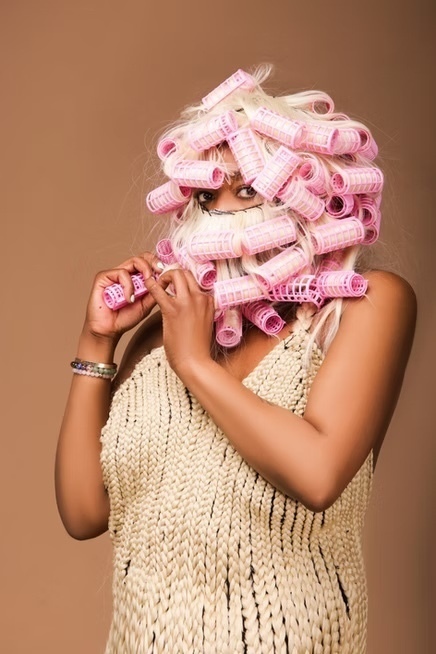
While your work engages deeply with history, it also focuses on the present lived experiences of Black people, especially with regard to hair. And many times you engage with both past and present at the same time; your project “Tignon Law,” where you created a quilt out of scarves and head wraps, is a good example. Elsewhere you include your work alongside opportunities to contribute to current social campaigns that are trying to end hair-based discrimination. In short, and to improvise a little on Lucille Clifton, your work “tends to the past” but also to the present. What present day effects of your art do you hope for?
I have always been interested in the connection of past and present. I believe that a crucial part in learning who we are is about learning where we come from. I hope that my audience continues to learn from my work, to gain further understanding of Black history, culture and identity. If we do not try to understand each other, how can anything change in how we interact with each other? I hope my work provokes reflection of self and of others.
What is something you hope that people at Notre Dame experience in response to your work and workshops? What should they expect? Do attendees need to have any prior experience with sewing, braiding, or quilting to join the memory quilt workshop?
In response to my work and workshops, I hope that people realize there are various ways to archive histories; our own as individuals and as a people. Overall I hope they gain a new skill all while having fun creating and reflecting; there is no need for prior experience, but sewing a basic stitch will help.
They should expect to create small textile collages using scrap fabric and imagery.