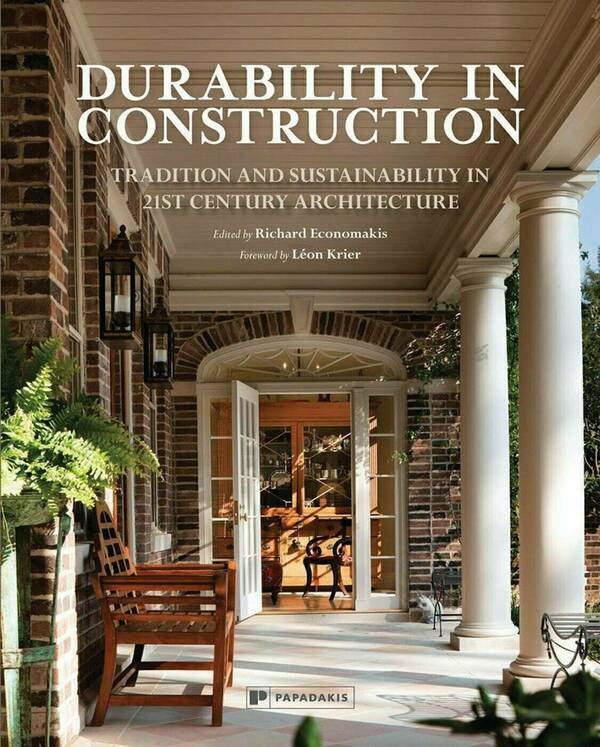
Born in Egypt to a Greek father and an American mother, and having lived in Greece, Switzerland, Italy, Britain, and currently the United States, professor Richard Economakis has lived the connections between cultures.
“They all seem different as they outwardly express differently, but they are tied together by commonalities that are stronger than the differences,” he said.
Growing up, Economakis experienced traditional urban life in different cities, which inspired him to pursue an architecture career that reinforced and supported the public realm. In his quest, he earned his undergraduate degree from Cornell University, and then worked in a number of prominent classical and traditional firms in Britain and the U.S. before teaching. He taught briefly at the Prince of Wales Institute in London, and later joined the University of Notre Dame, to be part of a reinvigorated effort at the school and across the nation to focus on teaching traditional architecture, which was happening at Notre Dame.
“One of the most important aspects of traditional architecture for me is durability. The places that we love, which tend to be historical, were designed not for a single generation, but for posterity. They were designed to be permanent and to be places that continue to welcome and embrace their residents,” Economakis said. “If buildings don't endure, then we can't be talking about a place with any consequence."
Economakis argues that traditional buildings, despite the irony, are futuristic.
“People talk about futuristic architecture, often described in terms of ephemeral materials. What could be more futuristic than a building that has lasted for thousands of years?” he asked rhetorically. For instance, he said, the Egyptian pyramids, Parthenon, and Pantheon have survived well into the future and are therefore futuristic.
“If we're talking about an architecture that we're constantly tearing down and rebuilding whenever it becomes obsolete because of the ephemerality of its materials or because it’s outlived its use, then we're talking about a very wasteful attitude about materials that hurt the environment," he said.
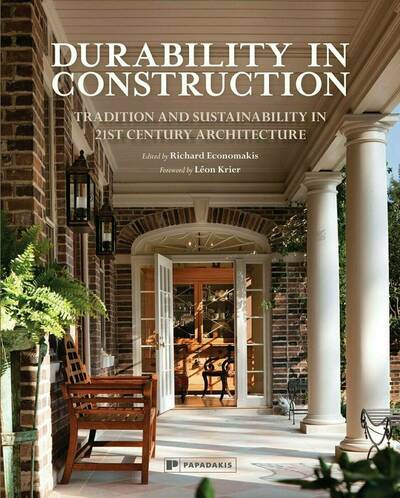
How can we use modern materials to achieve durability? The book provides reassurance to the profession, especially traditional architecture practitioners, that modern means of construction can be used to achieve this. In the book there are discussions about how to build durable buildings that have the same longevity as many historic buildings, and how to adapt modern techniques and materials into making that a reality. For instance, Lucien Steil writes about the use of a new product, known as Poroton bricks, which are thick masonry blocks containing insulation within their pores eliminating the need to include insulation in standard construction. Krupali Krusche writes about the reconstruction of the Dresden Neumarkt in Germany using those same blocks. John Simpson, in the Carhart Mansion, successfully adapted load bearing masonry to a concrete frame ensuring that it was waterproof and met code, but still designed to be there for centuries. Basically, embracing innovation whilst maintaining the principles of traditional architecture. Other A-listers have contributed in the book demonstrating how durability in construction can be achieved.
One of the considerations in enhancing durability is reducing the embodied energy of building materials. The industrial materials have to be mined, hewn, extracted, wrought, and transported over great distances to the site. The embodied energy that goes into this production impacts the environment profoundly. It's no longer an architecture of place, with the use of non-local materials. Economakis is confident that more and more designers can be faithful to the place while being innovative.
“People are appreciating the value of using local and natural materials as they are both environmentally sound and have a reliable efficiency. A growing number of architects are looking at what we're doing at Notre Dame, and some are represented in this book. There are a number of new industrial materials that are much more sensitive and sensible. So increasingly, the industry is turning in that direction,” he said.
Relating to buildings on the Notre Dame campus, Economakis appreciates how some of the older buildings were made to endure using bricks made of marl from St. Mary’s Lake, ensuring a near-zero embodied energy.
In contributing to the Notre Dame School of Architecture mission, the book was intended to complete a picture that students acquire when they join Notre Dame, which is not just learning about history, composition, design, structures, but also how it all comes together; how tradition is not just about the outward expressions of a building, but also about faithfulness to materials and a commitment to creating an enduring and sustainable place(s).
“It’s right behind you,” Economakis points to a large-scale model in response to what’s next for his work. He put together this model during a couple of years for his ongoing research on the origin of classical expressions and forms looking at ancient Greek temples.
“I noticed that the earliest mud-brick walled temples always had a row of slender posts in the middle carrying beams. I believe that the evidence points to the use of an anti-seismic technique to ensure buildings survived strong tremors,” he said.
The model is a hypothetical reconstruction of a part of such a building. Through this research, Economakis has a very practical approach. He is building on knowledge gathered through his experience, all the way back from when he spent ten summers in archeological excavations on the island of Crete in Greece studying the ruins.

Author: Charles Ghati, MSHP Candidate, Class of 2025. Charles is a registered architect in Kenya, where he practiced before joining the Notre Dame School of Architecture
Originally published by at architecture.nd.edu on October 09, 2024.