Institute for Social Concerns mural collaboration showcases longstanding relationship with Pokagon Band of Potawatomi
Long before South Bend carried its current name, the Pokagon Band of Potawatomi referred to the region as Ribbon Town, a name for the place they came to trade for ribbons and a subtle homage to the winding, braided bends of the St. Joseph River. Today, that ancestral metaphor comes to life across the outfield wall at the Foundry Field ballpark, where a vibrant new mural weaves together Pokagon history, athletic legacy, and community resilience.

The Pokagon panel marks the culmination of a multi-year effort conceived, directed, and sustained by the Institute for Social Concerns. Over successive years, Institute faculty and staff brought together community historians, neighborhood residents, local artists, and Notre Dame faculty and students to reclaim forgotten athletic stories.
The mural renders Pokagon memory in vivid movement and light. Sweeping blue ribbons of the St. Joseph River adorned with native florals flow across the wall. On one side, time dissolves as tribal leader Paul Hamilton — who signed professionally with the St. Louis Browns in the 1920s — appears as a young ballplayer delivering a pitch across a century to current Banana Ball Championship League player and member of the Pokagon Band Jordan Brewer. Hamilton appears again downstream the painted river in his father’s ceremonial headdress, an artifact preserved at Notre Dame’s Raclin Murphy Museum of Art. Further along the banks, former standout softball player Rhonda Purcell stands with her two children, her gaze anchored in the present as she leads vital work in tribal language preservation in the present.
“When designing the piece, I really wanted to show that we are a people who live in the modern world while remaining deeply connected to our heritage,” said artist David Martin, a citizen of the Pokagon Band and frequent collaborator with the Institute. “Our culture isn’t in the past; it’s how we survive, adapt, and continue as a people. Including the river and those small ribbon tendrils reminds us that everyone living in this town, no matter who you are, depends on that same river and land for life.”
This living history was emblazoned on the wall through intentional, personal engagement beginning in historical archives and moving into the classroom. In 2022, Michael Hebbeler, assistant director of community partnerships and programs at the Institute, began research in the Pokagon Band archives, where he discovered a photo of a regional 1910 Potawatomi baseball team. Building on that discovery, he co-taught the Institute’s Art & Social Change this fall with Geneva Hutchinson, program director of arts and community engagement. In the course, students sat shoulder-to-shoulder with Pokagon leaders and scholars. Kyle Malott, a Pokagon language specialist and great-grandson of Paul Hamilton, introduced students to tribal history and the spoken cadences of the Potawatomi language, while Moreau Postdoctoral Fellow Zada Ballew illuminated the Pokagon Band’s foundational role in the establishment of the University.

Through the Institute’s Story Lab, students transformed these classroom encounters into public scholarship, producing a series of educational postcards designed to extend the mural’s educational reach beyond the ballpark. Featuring mural imagery on the front and student-researched narratives on the back, the postcards explore topics ranging from the sacredness of the St. Joseph River and the heartbeat of the drum to traditional slow art-making, including black ash basketry crafted by Pokagon artisan Jamie Chapman Brown.
“Having lived in the South Bend area my entire life, I had always known of the Potawatomi tribe, but often from a distance,” said Henson Le ’29, a design and art history major in the course. “Learning directly from Dr. Zada Ballew and Kyle Malott opened my eyes to the rich, nuanced history of the Pokagon Band and their foundational role in our community. Creating these postcards allowed us to take those classroom encounters and share them with the broader public.”
For the Institute, completing this final panel also honors a deep institutional relationship that formally launched in 2022 with a permanent Pokagon Band art collection in Geddes Hall. As commemorated on the dedication plaque in the Geddes Hall Coffee House, this partnership is rooted in the Institute’s commitment to learn from and partner with the Pokagon community in order to foster justice, inspire harmony, and enhance connections with the land and each other.
“The Institute is Notre Dame’s scholarly home for justice, and through our Story Lab, we are committed to amplifying stories from underrepresented communities,” said Hebbeler. “Foundry Field exists because of an extraordinary network of neighborhood and civic partners. This field anchors our park, but these restored histories — of the Foundry Giants, the Mexican American Baseball League, and now the Pokagon Band — continue to ripple out across the entire city.”
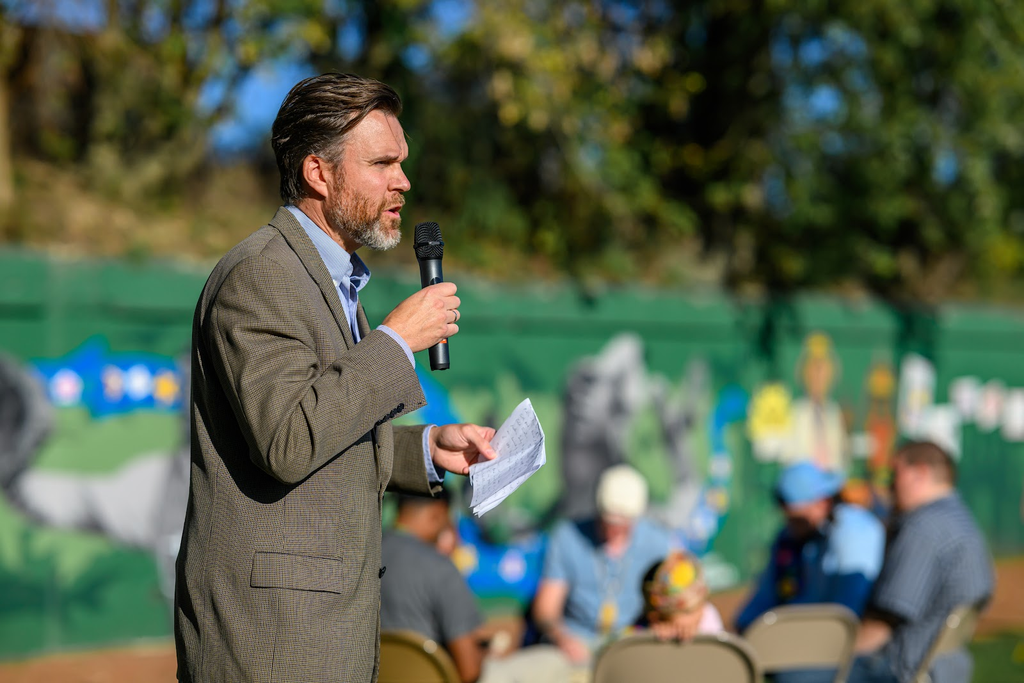
That living relationship animated Southeast Neighborhood Park during the mural’s autumn unveiling. Under a golden late-afternoon sun, the park swelled with life: elders leaning in to point out relatives on the wall, children racing along the baseline, drums beating in ancient rhythms by the Ribbon Town Singers, and neighbors sharing traditional rice soup and sandwiches from Rose’s Food Stand, one of the region’s oldest Native American food vendors. Lively conversations echoed across the field as Pokagon citizens, South Bend residents, and the Notre Dame community gathered at the newly painted wall.
The Pokagon installation completes a trilogy of Institute-led outfield murals, organized by the Foundry Field research team composed of the Institute’s faculty fellows Clint Carlson and Katherine Walden and Notre Dame sports archivist Greg Bond. It joins previous panels honoring South Bend’s predominantly Black Foundry Giants baseball team and the region’s historic Mexican American Baseball League. Together, these installations have transformed a neighborhood park into an immersive outdoor classroom that restores missing histories to the public square.
“Wendell Berry wrote of ‘love’s braided dance’ as the way we bind ourselves to one another, to our history, and to the places we inhabit,” said Suzanne Shanahan, the Leo and Arlene Hawk Executive Director of the Institute for Social Concerns. “When we bring together student research, public art, and genuine community relationships, we join in that same braided dance — demonstrating how academic scholarship and community wisdom can combine to cultivate a more just and beautiful world.”
Originally posted October 13, 2026, at https://socialconcerns.nd.edu/news/.