“People forget that science fiction is not really about the future but about the author in the present and what they’re concerned by.” So said best-selling and award-winning writer N. K. Jemisin in her recent visit to South Bend. Her visit signals the Franco Institute’s first off-campus public event in what will be an annual community series and was sponsored by the John and Patrice Kelly Endowment for Excellence.
On Tuesday, March 3, an audience of booklovers from the Michiana community and Notre Dame joined Jemisin at Stockroom East across from Howard Park in downtown South Bend. The event showcased Jemisin’s great ability to create work that serves as a powerful testament to how speculation and genre are among the best tools we have available to understand and act on our most difficult present dilemmas.
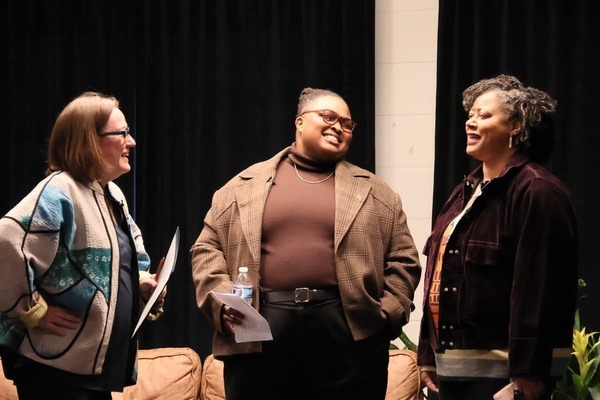
The event consisted of a fireside-style chat with the author, joined by Franco Director Kate Marshall and Cham Moore, an assistant professor of English at Butler University and 2021 Notre Dame Ph.D. A warm reception and book signing followed the discussion.
The conversation was enthusiastic and wide-ranging, centering around topics of hope and community. As Jemisin said, “It’s not jadedness I’m reaching for in my audience.” She expressed her staunch belief in the humanities and gave a ringing endorsement and vote of confidence in their importance. In particular, Jemisin shared her view that “Where bad literature projects [darker] human fantasies, good literature of whatever genre promotes and explores the human condition.”
Jemisin reflected on growing up Gen X and dividing her childhood between New York City and Mobile, Alabama and the independence expected of her. She also shared about her swift, unexpected rise in popularity as a writer and how she made the transition from her previous career in higher education administration as an academic counselor and internship coordinator. “For the first forty years of my life,” she said, “I was someone who just wrote stories for fun.”
After attending the Viable Paradise writing workshop, she began seeking publication in earnest. Although she acquired an agent in 2005, her first novel (The Killing Moon, eventually published in 2012) did not initially sell, as the genre at the time was significantly less welcoming to inclusive fantasy. Instead she rewrote from scratch an old "trunked" novel – which sold at six-figure auction to become The Hundred Thousand Kingdoms (2010) and its sequels. In 2016, her novel The Fifth Season (2015) won the Hugo Award for Best Novel, making Jemisin the first black person to have won in this category. In 2017 she won again for The Obelisk Gate (2016), and then a third time in 2018 for The Stone Sky, making her the first author in genre history to have won the Best Novel Hugo three consecutive times. In all, her short fiction and novels have won Hugos, a Nebula, and two Locus Awards, and have been translated into more than 20 languages. She is a MacArthur 2020 Genius Grant Fellow.
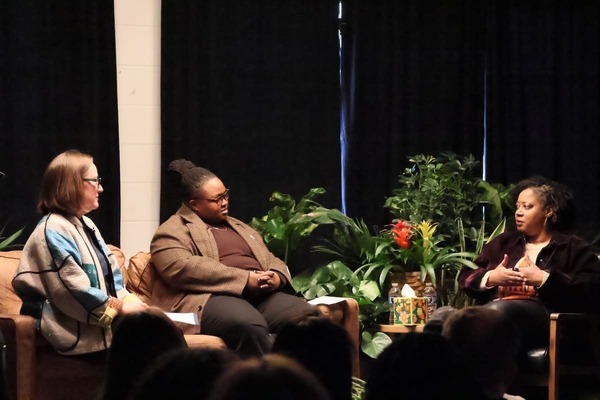
Jemisin advocated for diverse artistic endeavors and spoke about her own experience beyond her fiction to include scriptwriting for her television treatments and creating her graphic novel Far Sector with DC Comics’ Green Lantern line. As she said, “Trying different media helps me become a better writer.” In fact, while critics have often described Jemisin’s work as science fiction and fantasy, she resists applying such labels to her own writing. “I don’t draw lines. Period. I constantly remind myself that genre lines are marketing distinctions. Science fiction is just the vehicle I’ve found to tell my stories,” she said. Summing it up, she said, “Art is an urge to create. It is not bound by medium.”
Moore expressed excitement about moderating “such a dynamic conversation with Jemisin about how her stories are acts of nature that demand to be born onto the page, no matter the genre or medium.” Moore added, “Her writing is all a part of the same organism of powerful stories with a powerful impact for those that read them.”
Originally published by at franco.nd.edu on March 13, 2026.