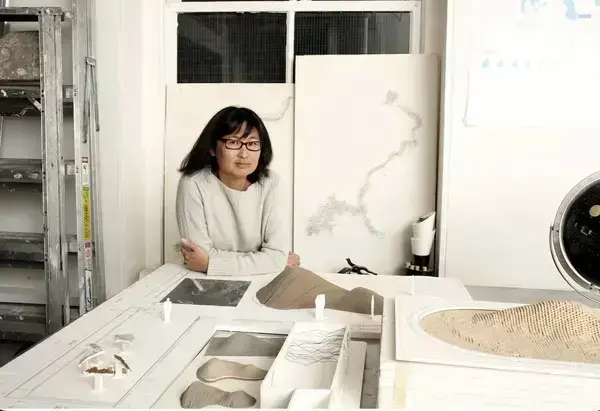
The Franco Institute, the Notre Dame Arts Initiative, and the Raclin Murphy Museum of Art are thrilled to welcome artist Maya Lin for a public conversation about her artistic and architectural practices. Lin will be in conversation with Joseph Becherer, Director and Curator of Sculpture at the Raclin Murphy Museum of Art, followed by a brief, moderated Q&A session with the audience.
Their conversation will take place in the Museum’s atrium, which prominently features Lin’s Silver Saint Joseph Watershed (2023), a commission by the Museum to celebrate one of the region’s defining physical, sociological, and environmental elements. Silver Saint Joseph Watershed is one piece in Lin’s extraordinary body of work of public memorials, sculpture, earthworks, and sustainable, site-responsive structures that often engage ecological interdependence and the symbiotic relationship between humans and the built or natural environment.
Maya Lin is a visionary artist who has created a remarkable and complex body of work, encompassing sculpture, architecture, and memorials, that explores our history and culture, our relationship with the natural environment, and the passage of time. From her very first work, the Vietnam Veterans Memorial in Washington, DC, which she designed as a 21-year-old Yale undergraduate, she has forged a unique and highly acclaimed practice in both architecture and art. She has continued to create memorials including five of groundbreaking design that focus on some of the critical issues of our time. Architectural works such as the Novartis Campus in Cambridge and the Nielsen Library for Smith College, as well as a performing arts lab center for Bard College, are exemplary for their design, sustainability, sensitivity to the environment, and deeply human spaces. Her artworks have created a unique voice in large-scale environmental earthworks, and her studio sculptures are in the collections of the Metropolitan Museum of Art, the Whitney Museum, and the National Gallery of Art, among others.
Seen as a whole, Lin’s body of work is a remarkable achievement. To have earned consistent success and renown in the three distinct disciplines of art, architecture, and the creation of memorials is extremely rare; to have done so as a woman and the child of immigrants, in fields still overwhelmingly dominated by male practitioners, is unparalleled.
Lin’s achievements have been widely recognized. She was one of the youngest women to be inducted into the Women’s Hall of Fame, and she has been elected to membership in both the American Academy of Arts and Letters and the American Academy of Arts and Sciences. She has been profiled in TIME, The New York Times Magazine, and The New Yorker, among many other outlets. Freida Lee Mock’s 1996 documentary, Maya Lin: A Strong Clear Vision, won the Academy Award for Best Documentary. In 2009, she was awarded the National Medal of Arts, the nation’s highest honor for artistic excellence, and in 2016, President Barack Obama awarded her the nation’s highest civilian honor, the Presidential Medal of Freedom, praising her for a celebrated career in both art and architecture, and for creating a sacred place of healing in our nation’s capital.
This is a signature program of the Notre Dame Arts Biennial, funded and organized by the Franco Family Institute for Liberal Arts and the Public Good, the Notre Dame Arts Initiative, and the Raclin Murphy Museum of Art. Learn more about the Franco Institute’s annual research theme, interdependence, and the 2027 Biennial’s theme, symbiosis.
This event is free and open to all.
Originally published at raclinmurphymuseum.nd.edu.