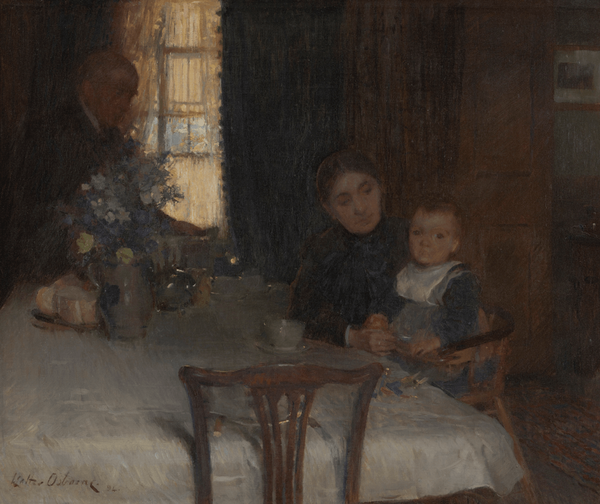
Join the curators of Homecoming: Walter Osborne’s Dublin, 1880–1900 every Football Friday for an introduction to one of Ireland’s most acclaimed artists, as well as the people he knew and the places he visited. From luscious parks to bustling market scenes, quiet libraries and churches to intimate domestic interiors, Osborne’s luminous depictions of everyday life offer insights into Ireland’s changing realities at the turn of the twentieth century.
Meet at the entrance to the Temporary Exhibition Gallery. All are welcome.
Go Irish!
Originally published at raclinmurphymuseum.nd.edu.
Learn more
Whether you're unable to attend the tour or simply interested in learning more about the exhibition, PhD candidate in English, Spencer French, toured Homecoming: Walter Osborne’s Portraits of Dublin 1880-1900 with Keough Curatorial Fellow Aoife-Marie Buckley and shares his experience below.
Something rare is happening at Notre Dame. Something moving and human.
Near the parking lots that host the joyful ruckus of tailgates and desperate hopes that the football team wins out, lives one of the most compelling art exhibitions I have ever witnessed in my life: Homecoming: Walter Osborne’s Portraits of Dublin 1880-1900. It tells the story of incredible talent, of familial loss, and of making beauty in the midst of that loss.
This singular artistic event is on view at the Raclin Murphy Museum of Art, the result of a multi-year curatorial initiative on an essential Irish painter. And it just so happened that one of the curatorial fellows on the project was a friend—Aoife-Marie Buckley.
I asked Aoife (pronounced, EE-fah), a Ph.D. candidate in art and architectural history at Trinity College Dublin, if she would be willing to walk through the exhibition with me. She heartily agreed. So, on a brisk Tuesday afternoon in mid-October we met in the gallery—empty, presumably, because of fall break and the drizzle—, and she began telling me the story of Walter Osborne.

We started with some of his early, more naturalistic work. Scenes of heavily wooded rivers and landscapes showed, even at a young age, that Osborne was talented and ambitious. His painting A Glade in the Phoenix Park (1880), completed in his early twenties, won two major awards. The prize money allowed him to do what many Irish painters had to do at the time to receive artistic viability in the wider European market—leave to be trained in London or Paris, or with those who had been trained in London or Paris. He left to study under a painter from the latter camp in Belgium.
We continued through Osborne’s early travels, journeying alongside his oil studies and sketches from various places. I had two simultaneous impressions: first, that this exhibit was about a deeply talented painter who was practicing, honing, mastering his craft. It had a bildungsroman (“coming-of-age”) quality to it. Second, that it was all leading to something big and, I feared, catastrophic. I asked Aoife about this intuition. She smiled, “Let me show you that moment.”
We walked over to the narrow maroon passway that served as the emotional core of the exhibition, bisecting Osborne’s career. Here in the middle, there is one painting that is the hinge of Osborne’s creative and personal life, and that hinge is rooted in tragedy.
At the Breakfast Table (1894) was the impetus for the exhibition. It was purchased with the support of the Donald and Marilyn Keough Foundation for the permanent collection at the Raclin Murphy Museum of Art under the guidance of the Curator for European and American Art before 1900, Cheryl Snay. She also directed the subsequent exhibition, alongside Judith Stapleton and Aoife, the former and current Keough Curatorial Fellows, respectively. Part of the vision behind buying the painting was mounting the first showing of Osborne’s work in the States.
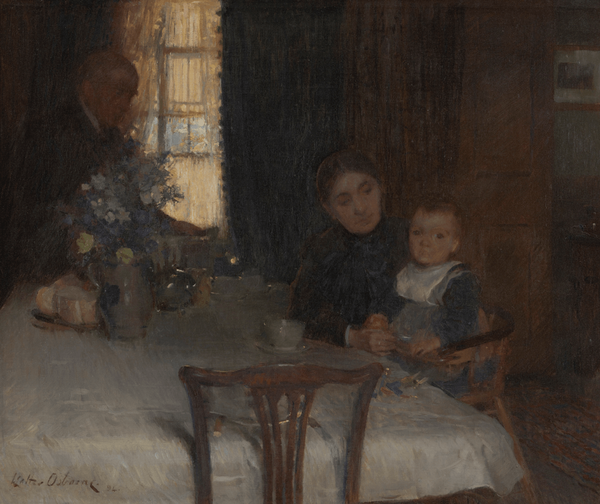
Aoife and I stood in the passway, staring at the painting. I first saw the brightly lit table—the brushstrokes like furrowed cloth, all cream color—and the two people sitting at it, an older woman and a toddler being held. Then I saw the light beaming through the back window, with just enough green and blue to suggest a garden. The light threw the old man standing nearby into silhouette, as he looked solemnly at his hands. It was odd for a family portrait; there was too much darkness for a mere domestic celebration. I suddenly noticed that the child was looking at us.
Aoife broke the silence, pointing to the older man, “That is William Osborne, Walter’s father, who was an animalier.” I looked at her blankly. “That is, he painted animals—prize cows, racehorses, hunting dogs and the likes. Though by the time of this painting the economy was slower, as was he in his age. This woman was his wife, Walter’s mother, Anne Jane Osborne. And that,’ she continued, gesturing toward the child, “is Violet, Walter’s niece.” “Where’s her mother?” I asked. Aoife responded, but with something distant in her voice not unlike grief, “Well, that’s why this painting is so important.”
“Walter Osborne’s sister—who was also named Violet—died in childbearing. She lived in Canada at the time. She died far away from her family. They gave her daughter the same name in her honor.” I paused, and Aoife filled the silence, “It changed Walter’s art career forever. From then on, he spent the rest of his life painting in and around Dublin, staying largely in Ireland.” Osborne’s friend, the writer Stephen Gwynn, puts it well, “[Walter’s] home in Dublin was a pleasant centre [sic] at all times, and more so when he came home: yet the life and the soul of it was his sister.” Gwynn wrote this before she died.

“Another thing to note about the painting is that, by originally calling it Portraits, Osborne was trying to market himself to a wider audience. He didn’t paint many portraits before this moment, but he shifted here and after, because there was more money in portraiture and he needed to support his family who, in turn, needed to support Violet.”
Aoife pointed to the empty chair at the front of At the Breakfast Table. “There is an absence at the table, is it for Walter or his sister? I’d like to think his sister.” Then she swiveled and pointed at the wall opposite the painting where there was a portrait of a young woman, the artist’s sister herself. “Look at her eyes,” I exclaimed, “she’s staring at us. No, through us.” Aoife rejoins, “She is looking across at her daughter and parents.”
In an act of curatorial grace, we not only get to see Osborne’s works side-by-side, but also encounter daughters and mothers together again.
There is so much else to say of the work that follows At the Breakfast Table. How Osborne painted the working people of Ireland with dignity and honesty—humanizing portraits of Dublin and those who lived there. How he loved painting children, and when he did, he would sing songs to help them relax. He also had a rule that when he had a commission for a portrait of a child the only person who could give commentary on it was the child. In all of this we see something more important than a talented artist, we see a kind and gentle man who used his passion for painting to help others be seen with deeper humanity. Three decades later, the Irish poet W. B. Yeats, whose brother John Butler Yeats was a fellow Irish portrait artist who actually painted Violet the year she was engaged, would write about the choice that he thought every artist must make:
The intellect of man is forced to choose
perfection of the life, or of the work,
And if it take the second must refuse
A heavenly mansion, raging in the dark.
In Osborne’s life, we see no such compromise. His portraits of children are the perfect example of this, where cultivated talent is joined with the echoes of a doting uncle on his darling Violet. In fact, he painted her frequently, including, in his last painting, Tea in the Garden (1903), unfinished because Walter’s life, too, ended with tragedy—he died of pneumonia at 43.
……
I could encourage you to visit the Walter Osborne exhibition on its reputation alone: it is, without a doubt, the largest and most comprehensive American exhibition of one of the most important Irish painters of the last two centuries. I could encourage you to attend on its artistic merits: the paintings are complex and interesting and political in the best sense of the word—engaged with the life and times of the polis (which is Greek for “city”). I could encourage you to visit in order to understand more about Irish life through the eyes of an Irish painter, especially since our University has been influenced by and positions itself alongside that identity. All of this is true, but my encouragement to experience this art event, dear reader, is simpler and more personal:
Go there to see a brother make beauty out of the space left by his dear late Violet.
Go there to see a proud uncle render humanity inspired by his delight of his dear darling Violet.
Go there to stand a little while in the distance between a mother and daughter who never met, who bear the same name, staring at each other.
They are reunited for this short time, and it is an intimate and moving grief to behold.
The exhibition, Homecoming: Walter Osborne’s Portraits of Dublin 1880-1900, remains on view at Raclin Murphy Museum of Art through December 7, 2025. The museum is free and open to the public Tuesday through Friday 10am - 5pm (with extended hours on Thursdays until 7:30 pm) and weekends noon - 5pm.